
 TRAE-AI编程


Java 打印样式格式
Java格式 - Java 打印样式格式
java.util.Formatter 类支持printf样式格式化。
printf样式格式化是C编程语言的良好支持。
以下代码在Java中使用C的Printf样式格式。
import java.util.Date;

public class Main {
  public static void main(String[] args) {
    // Formatting strings
    System.out.printf("%1$s, %2$s,  and  %3$s %n", "ABC", "DEF", "XYZ");
    System.out.printf("%3$s, %2$s,  and  %1$s %n", "ABC", "DEF", "XYZ");

    // Formatting numbers
    System.out.printf("%1$4d, %2$4d, %3$4d %n", 1, 10, 100);
    System.out.printf("%1$4d, %2$4d, %3$4d %n", 10, 100, 1000);
    System.out.printf("%1$-4d, %2$-4d,  %3$-4d %n", 1, 10, 100);
    System.out.printf("%1$-4d, %2$-4d,  %3$-4d %n", 10, 100, 1000);

    // Formatting date and time
    Date dt = new Date();
    System.out.printf("Today is  %tD  %n", dt);
    System.out.printf("Today is  %tF  %n", dt);
    System.out.printf("Today is  %tc  %n", dt);
  }
}
上面的代码生成以下结果。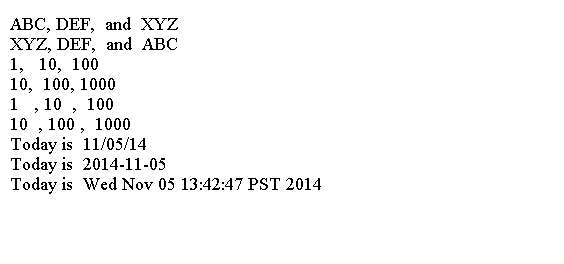
格式化类
我们可以使用System.out.println()和System.out.print()方法在标准输出上打印文本。
System.out是java.io.PrintStream类的一个实例,其中有println()和print()实例方法。
PrintStream类还有 format()和 printf()它可以支持printf样式的格式化。
String类的静态format()也支持printf样式的格式化。
PrintStream类的format()/printf()方法和String类的format()静态方法的格式化行为是相同的。
PrintStream类中的format()/printf()方法将格式化的输出写入输出流,而String类的format()方法返回格式化的输出。
PrintStream类的format()/printf()方法和String类的format()静态方法取决于Formatter类。
格式化程序用于格式化文本,可以写入以下目的地:
- 附加(例如StringBuffer,StringBuilder,Writer等)
- 文件
- 输出流
- 打印流
以下代码显示如何使用Formatter类来格式化数据并将结果存储在StringBuilder类中。
import java.util.Date;
import java.util.Formatter;

public class Main {
  public static void main(String[] args) {
    StringBuilder sb = new StringBuilder();
    Formatter fm = new Formatter(sb);

    // Formatting strings
    fm.format("%1$s, %2$s,  and  %3$s %n", "A", "B", "C");
    fm.format("%3$s, %2$s,  and  %1$s %n", "D", "E", "F");

    // Formatting numbers
    fm.format("%1$4d, %2$4d, %3$4d %n", 1, 10, 100);
    fm.format("%1$4d, %2$4d, %3$4d %n", 10, 100, 1000);
    fm.format("%1$-4d, %2$-4d,  %3$-4d %n", 1, 10, 100);
    fm.format("%1$-4d, %2$-4d,  %3$-4d %n", 10, 100, 1000);

    // Formatting date and time
    Date dt = new Date();
    fm.format("Today  is %tD  %n", dt);
    fm.format("Today  is %tF %n", dt);
    fm.format("Today  is %tc %n", dt);

    // Display the entire formatted string
    System.out.println(sb.toString());

  }
}
上面的代码生成以下结果。
格式化为文件
要将所有格式化的文本写入文件,请使用以下代码。
我们必须处理FileNotFoundException,如果指定的文件不存在,它可能会从Formatter类的构造函数抛出。
我们必须调用它的close()方法来关闭输出文件。
import java.io.File;
import java.io.FileNotFoundException;
import java.util.Formatter;

public class Main {
  public static void main(String[] args) {
    File file = new File("xyz.txt");
    Formatter fm = null;
    try {
      // Create a Formatter that will write the output the file
      fm = new Formatter(file);

      // Formatting strings
      fm.format("%1$s, %2$s,  and  %3$s %n", "A", "B", "C");
      fm.format("%3$s, %2$s,  and  %1$s %n", "A", "B", "C");

      // Format more text here...
    } catch (FileNotFoundException e) {
      e.printStackTrace();
    } finally {
      if (fm != null) {
        fm.close();
      }
    }
  }
}
formatatter()方法
Formatatter的format()方法是重载的。其声明如下。
Formatter format(String format, Object... args)
Formatter format(Locale l, String format, Object...  args)
format()方法的第一个版本使用默认语言环境进行格式化。第二个版本允许您指定语言环境。
PrintStream类的format()/printf()方法和String类的format()方法支持format()方法的这两个版本。
















更多建议: